



Derivatives Trading, Backed by Expertise
Futures and Options let you take a strategic view on the market — for hedging, speculation, or disciplined income strategies — without owning the underlying stock outright. Our Derivatives desk offers real-time risk tracking so you can trade F&O with clarity, not just conviction.
From index and stock derivatives to live margin tracking, from expiry-day strategies to hedging tools — we’ve got it covered.
Understanding Derivatives
A derivative is a contract whose value is based on an underlying asset — a stock or an index like the Nifty or Bank Nifty. Futures obligate both parties to transact at a set price on a future date. Options give the buyer the right, but not the obligation, to buy or sell at a fixed strike price before expiry. Both instruments trade in standardized lots and expire on fixed dates set by the exchange.

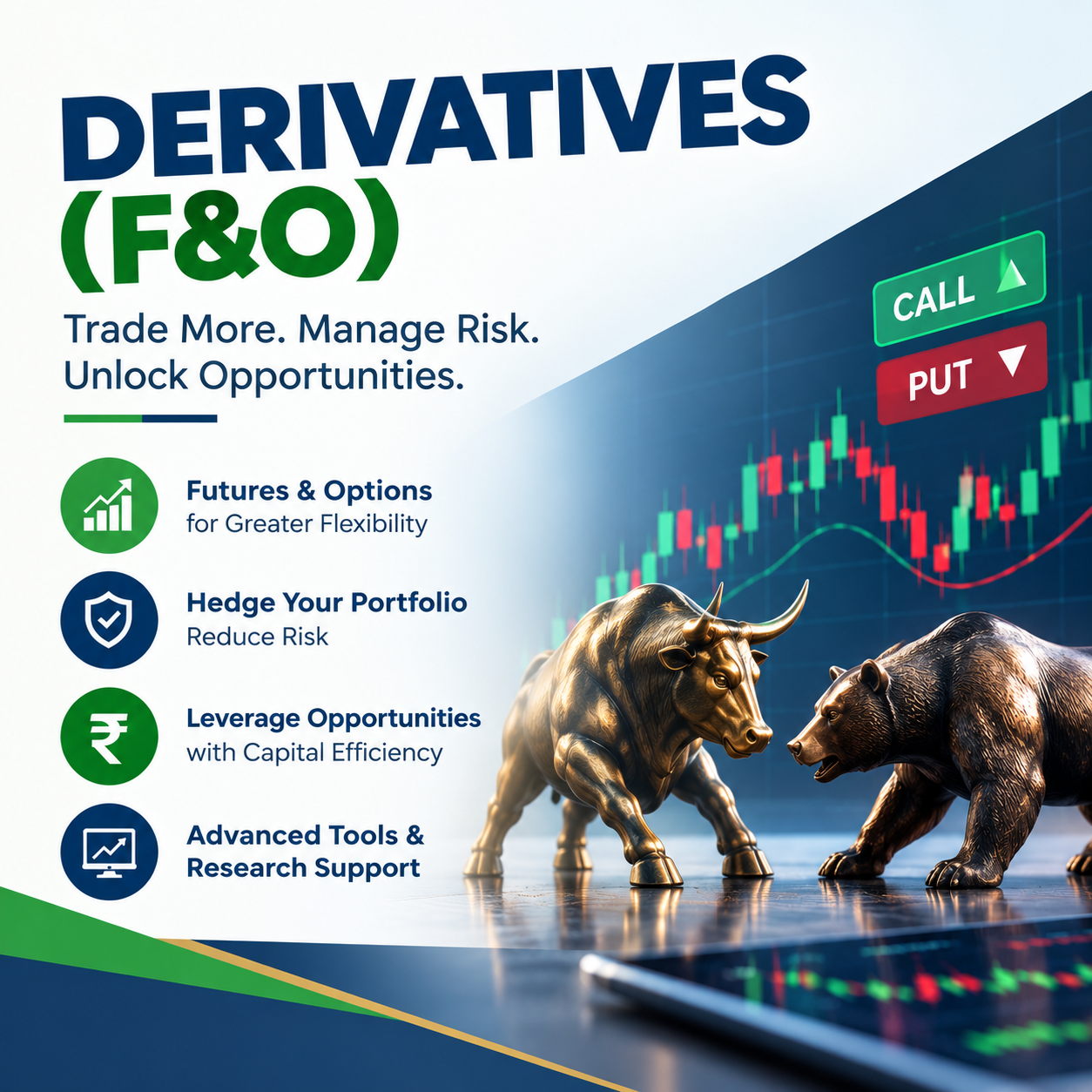
Derivatives Trading Solutions
- Index Futures — Take a view on the broader market (Nifty, Bank Nifty) through standardized futures contracts.
- Index Options — Trade Call and Put options on major indices, including weekly expiry contracts.
- Stock Futures — Take a leveraged position on individual NSE-listed stocks.
- Stock Options — Buy or write Call and Put options on stocks, for both directional and strategy-based trades.
- Hedging Solutions — Protect existing equity holdings from near-term downside using Put options.
- Real-Time Margin & MTM Tracking — Monitor your position risk and margin requirements live through your trading session.
Benefits of Trading Derivatives
- Leverage — control a larger position with a smaller upfront outlay.
- Hedge existing equity portfolios against market volatility.
- Flexibility to profit in rising, falling, or sideways markets.
- Weekly and monthly expiry cycles for varied strategy horizons.
- Transparent, exchange-regulated contracts.
Why Trade Derivatives with K&G?
- Real-time margin and MTM visibility on every position.
- SEBI-compliant risk framework and transparent margin norms.
- Fast, reliable order execution during volatile sessions.
Frequently Asked Questions
- What is the difference between Futures and Options?
Futures obligate both buyer and seller to transact at expiry. Options give the buyer a right, but not an obligation, to transact — the buyer’s maximum loss is limited to the premium paid. - How much margin do I need to trade F&O?
Margin requirements vary by contract and are set by the exchange (SPAN + exposure margin for futures and option writing; only the premium for buying options). Your K&G dashboard shows live margin requirements. - Is F&O trading suitable for beginners?
F&O involves leverage and higher risk than cash market equity trading. It’s best suited to traders who understand margin, volatility, and disciplined risk management — our team can help you assess if it’s right for you. - Can I use derivatives to protect my equity portfolio?
Yes — buying Put options is a common way to hedge an existing equity portfolio against a market decline. - What happens if I don’t square off my position before expiry?
Futures and in-the-money options are settled as per exchange rules on expiry; out-of-the-money options expire worthless. Your K&G team can walk you through expiry-day handling.